A printable home maintenance binder should answer common questions quickly: What equipment do we have? Who serviced it? What was repaired? What needs attention next? Where are the warranty and contractor details?
Recommended binder sections
1. First-month priorities
Begin with a short move-in checklist for locks, utility controls, alarms, visible leaks, equipment labels, and emergency information. Keep this section concise so it can guide action rather than become another document to organize.
Use the printable new homeowner checklist guide to build this section.
2. Emergency and essential-control information
Record verified locations and instructions for the main water shutoff, electrical panel, utility emergency contacts, alarms, exits, meeting points, and household needs. Do not include unnecessary passwords, access codes, or full payment information.
3. Home systems and equipment
Create one summary page for each major system or appliance:
- Equipment name and location
- Manufacturer, model, and serial number
- Installation date where known
- Filter, battery, or consumable details
- Warranty contact and expiration information
- Service history and next planned action
Start with the free appliance and equipment inventory worksheet.
4. Contractors and service providers
Keep contact information, scope summaries, dates, invoice references, warranties, and follow-up notes. A contractor page should help you remember what was actually agreed to—not replace the signed contract or invoice.
Use the free contractor contact list for past service providers. Before hiring, use the contractor-estimate comparison framework.
5. Repair and maintenance history
For each meaningful repair or service, record:
- Date and affected system
- Observed problem or reason for service
- Company or person who performed the work
- Summary of the completed scope
- Cost and invoice location
- Warranty or follow-up information
Keep the detailed invoice in secure storage and note where it can be found.
6. Seasonal and recurring routines
Include monthly, seasonal, and annual review pages. Adapt them to your climate, property type, equipment, manufacturer instructions, and local professional guidance.
The seasonal maintenance guide and monthly checklist provide a starting framework.
7. Projects and replacement planning
Separate routine maintenance from known repairs, improvements, and long-term replacement planning. Record the question, estimated timing, current information, and next decision rather than treating every future project as urgent.
Use the free home project planner to organize one repair or improvement from goal through closeout.
Paper binder, digital file, or both?
Paper binder
Easy to write in, scan quickly, and share with household members. Store sensitive details carefully.
Digital copy
Easy to back up, update, search, and attach to related invoices or photos. Use secure storage appropriate to the information.
Hybrid system
Keep working pages in print and secure source documents digitally. Note where each detailed record is stored.
Annual review
Remove outdated contacts, update equipment, record completed work, and carry unfinished projects forward.
What should not go in an ordinary maintenance binder?
Avoid placing passwords, alarm access codes, full bank or payment-card information, government identification numbers, unnecessary medical or financial records, or original legal documents in an easily accessible household binder.
The binder can note that a deed, policy, inspection report, invoice, or warranty exists and where it is securely stored without containing every sensitive page.
Build your own or use a ready-made binder?
Building your own binder gives you complete control but requires deciding on sections, formatting pages, and keeping the system consistent. A ready-made binder is useful when you want to begin with an organized structure and customize it as you learn the home.
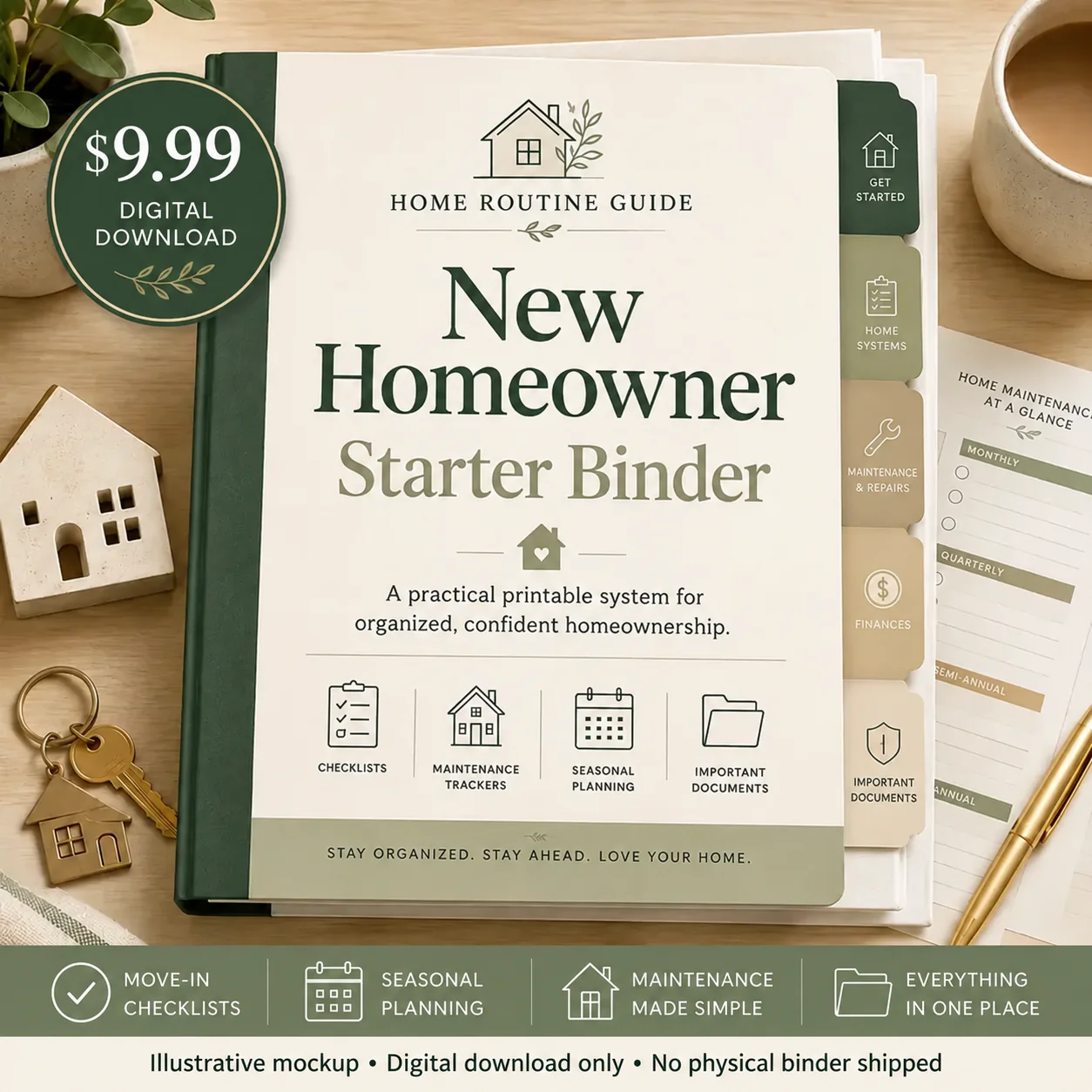
New Homeowner Starter Binder
The enhanced 44-page binder turns the sections above into guided worksheets with specific prompts, examples, and reminders about what to enter. It covers first-month priorities, shutoffs, home systems, equipment, warranties, contractors, service and repair history, moisture incidents, maintenance routines, budgeting, replacement forecasting, and projects.
- 44 guided printable pages
- Specific prompts instead of generic blank forms
- Instant digital delivery through Kit
- No subscription required
Educational and organizational use only. Review the digital product terms and refund policy.
Start smaller when that is enough
Not every homeowner needs a full binder immediately. Start with the free First 30 Days workbook when your priority is the move-in sequence. Add a broader system only when scattered notes and separate files begin making routine decisions harder.